I finally played through Bioshock Infinite (I had been waiting until I would have some time to focus on it, so over break I binged over the course a couple days) and now I'm catching up on all the commentary and reactions to it, which are quite interesting.
Theres one thing I want to comment on though, and that's Infinite's vigors (their version of plasmids from Bioshock 1). The (entirely accurate) criticism floating around is that they're not really part of the world and they're out of place and make allot less sense than in Bioshock 1. In 1, they were integral to the story, and part of the narrative was the consequences of their existence, while here you get superpowers casually, none of the other inhabitants have them (even though you can buy them out of very common vending machines), and basically the game gives them to you the protagonist, then ignores them.
Now, from the story, narrative, and world-building perspectives that's just awful. Its weird and distracting and what is the point of it? However, from a gameplay perspective, I can say the game would absolutely have been less interesting without them. Whatever else Bioshock Infinite is, its a shooter and allot of play time is in combat that is significantly richer, more interesting, and more engaging for having vigors.
To me its about doing something because of the medium, to make it more effective, rather than the message. For example, I vaguely remember Faulkner originally wanted one of his books to be printed with each character's thoughts and speaking in a different color ink (but didn't because it was too expensive). It seems like if you had a book that made a big deal about the symbolism of color and it was intimately connected to the characters and an integral part of the work, and it was very well received. Then with your next book, even though it had nothing to do with color (but was similar in other themes) you still used different colors because it did make it easier to keep track of things and made the book easier to follow and enjoy. That's what it makes me think of; something done due to the medium (in this case shooter) to make it more enjoyable that isn't well connected to the story.
(And yes, I know the vigors are more problematic because they exist in world, while the ink colors wouldn't necessarily be, but whatever)
Now whether, you think the detriment to the story is worth the benefit to the gameplay is an interesting and personal question and matter of priorities. As I said, I think it would have been less interesting and fun without them, personally, and didn't really care that the story ignored them.
But what about you? What do you think about the balance of narrative and gameplay concerns?
Here, in other specific games, or generally?
Showing posts with label rpgs. Show all posts
Showing posts with label rpgs. Show all posts
Saturday, December 28, 2013


Monday, September 23, 2013
PC vs. Tabletop Gaming for Characters
As you may have noticed from previous posts, I'm a big fan of tabletop rpgs and board games as well as video games. Now this leads to one of the interesting little tensions I have with discussing video games; recreationally, I don't really play them to explore character or story, but basically just for gameplay. Thats not to say story or character aren't important, or I don't appreciate them. A better story and characters were a big part of the improvements between Borderlands 1 and 2, though both great.
But if I actually want to explore a character, I do it in tabletop. Its just not even a comparison (If you have a good group and Game Master). With a tabletop game, you can literally do anything you and the GM can come up with, possibly on the fly if they're good at ad-libbing. When Yahtzee talked about Fable 2 he made a joke about "Why can't I marry my dog?" and even if you still can't in Fable 2: the TTRPG, you could roleplay out your character meeting with officials and clergy trying to set it up, if that was something you really wanted to explore and the Gm and other players were ok with.
As opposed to just not having the affordance, not even having an option. To be clear, I'm not saying Fable 2 should've allowed you to marry your dog; its an example of a GM being able to adapt the game to player interests, rather than letting them explore within more concretely defined boundaries, aka the things programmed in.
Now, within those rules, video games can be absolutely amazing. If I want to hack n' slash, build a base and lead an army, shoot things in the face, pilot a spacefighter, or even explore a world while doing those things, video games can be great.
Thats the thing though; I'll play those games to do those specific things, because they're great at them. But the characters in those games can only do the things that the designers thought of them doing. Video games are interactive and do let you affect the story and how things happen, but its just on a different scale from a tabletop game, where you can end up going in completely different direction than was originally intended, for better or worse.
This does make it interesting talking about video games as a storytelling medium, though. They still tell great stories, and let you create great characters and affect the world. They have the potential to create really dynamic worlds the shift with your actions. I love watching the medium develop...but right now it just can't compare to a skilled human being pulling on notes and making up stuff on the fly for me.
What about you?
Photo credit: dogcentral.info, tweakguides.com, ohiobusinesscollege.edu
 |
| Also 2 had a villain you could really love to hate. |
 |
| "This is not how the campaign was pitched to me. . ." |
Now, within those rules, video games can be absolutely amazing. If I want to hack n' slash, build a base and lead an army, shoot things in the face, pilot a spacefighter, or even explore a world while doing those things, video games can be great.
 |
| And ye gods the atmosphere and immersion, when done right. |
This does make it interesting talking about video games as a storytelling medium, though. They still tell great stories, and let you create great characters and affect the world. They have the potential to create really dynamic worlds the shift with your actions. I love watching the medium develop...but right now it just can't compare to a skilled human being pulling on notes and making up stuff on the fly for me.
 |
| "Thats right, as the king goes to shake my hand I fireball him. What now?" |
Photo credit: dogcentral.info, tweakguides.com, ohiobusinesscollege.edu
Wednesday, March 31, 2010
Best Game Company?
So, most every major TTRPG that companies have come out with has serious balance issues:

Basically it seems game companies just suck at playtesting. Like really suck. And economics and demand say they aren't gonna fix it, cause theres enough other stuff in their products that unbalanced mechanics don't nix the deal...mostly. The bigger issue is that they have limited time even when they do playtest, so they won't find everything the rabid masses of obsessed fans will. Charop boards thrive on this fact.
So if the only way to truly stress test a system is to give it to hoards of powergaming fans; in a perfect world (or at least one where 1) companies didn't care about giving away product for free or 2) people would still buy the finished product after having the drafts of the system) we'd just do that. I mean homebrews start as small things or houserules to something established, but if a group put its mind to it theres no reason the people that brought you Crystal Keep and all the "The 3.5 X class handbook" threads that reviewed every option from every splatbook couldn't turn their efforts to actually balancing things, instead of noting the problems and moving on. And this does occur sometimes, but what i'm saying is this writ large accross a whole game, including its fundamentals.
Wikis and boards and such allow input from all sides, and the real issue is everyone having the same goal; a clear statement of purpose outlining direction and philosophy is essential here. So many design calls come down to preference and style, so having a cohesive idea of what the game is for and whats most valued (cinematic vs. gritty, ease of use, flexibililty, etc.) saves allot of repetitive arguments later.
I guess I'm saying gamers, properly motivated and organized, would form their best group of suppliers. If theres any group that would voluntarily put in the time both figuring out fair dice mechanics and fluffing out new setting to go with them it'd be the people in this hobby.
- DnD 3.x: does mages vs. fighters really need a link?
- Pathfinder: the lowdown
- DnD 4e: a "good character" (the responses, not neccesarily the first post)
- nWoD: I can't speak to this as much, but for reasons below (and new mage's "lol atlantis" fluff) I don't have much faith in WW
- Exalted: Anatomy of failure
- Aberrant: various views (this is by no means a major system, but I like fiddling with it occasionally. Also both the bits where 1) claws power vs. str enhancement, where one option is both cheaper and better in every way and 2) the default character creation that allows for characters that would be 306-1198xp if bought with that, makes me giggle)
- Scion: anything past Hero level. Dex is already the god stat, so how do you even fight without maxing out epic Dex? and why are the aesir dex-screwed? What does 10 successes even look like and why doesn't that do half the things dex knacks do?

In some games these are starting characters,
in some they are balanced with each other,
in some they are both
Basically it seems game companies just suck at playtesting. Like really suck. And economics and demand say they aren't gonna fix it, cause theres enough other stuff in their products that unbalanced mechanics don't nix the deal...mostly. The bigger issue is that they have limited time even when they do playtest, so they won't find everything the rabid masses of obsessed fans will. Charop boards thrive on this fact.
So if the only way to truly stress test a system is to give it to hoards of powergaming fans; in a perfect world (or at least one where 1) companies didn't care about giving away product for free or 2) people would still buy the finished product after having the drafts of the system) we'd just do that. I mean homebrews start as small things or houserules to something established, but if a group put its mind to it theres no reason the people that brought you Crystal Keep and all the "The 3.5 X class handbook" threads that reviewed every option from every splatbook couldn't turn their efforts to actually balancing things, instead of noting the problems and moving on. And this does occur sometimes, but what i'm saying is this writ large accross a whole game, including its fundamentals.
Wikis and boards and such allow input from all sides, and the real issue is everyone having the same goal; a clear statement of purpose outlining direction and philosophy is essential here. So many design calls come down to preference and style, so having a cohesive idea of what the game is for and whats most valued (cinematic vs. gritty, ease of use, flexibililty, etc.) saves allot of repetitive arguments later.
I guess I'm saying gamers, properly motivated and organized, would form their best group of suppliers. If theres any group that would voluntarily put in the time both figuring out fair dice mechanics and fluffing out new setting to go with them it'd be the people in this hobby.
(Those drawn to the mechanics, anyway; I know allot of people play socially or only care about story and often handwave mechanics, which is great for them and their groups. The arcane (not in the magic sense) structure of say dnd 3.5e can attracts a type of person who is great for this, though.)
Thursday, March 11, 2010
Why play?
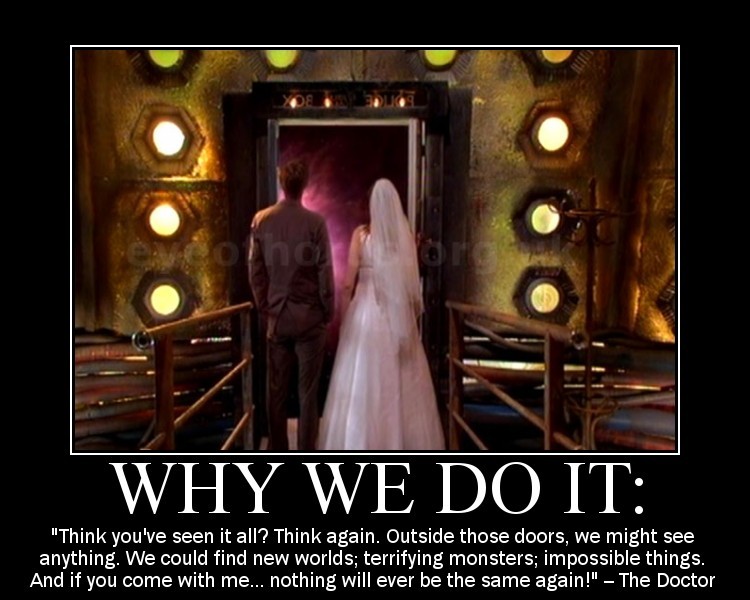
Why do we play rpgs? I mean theres tons of reasons and they'll be different for everyone, but it feels like theres some common core. So much that lots have tried to voice it (and left pictures), but I found a part recently that often gets left out.
This isn't quite the problem, but close.
And not only is it so much simpler if you could directly fix something, like kill the dragon terrorizing people or overthrow the evil king, but then you have the sense of achievement of having done something. Eternal vigilance may be more realistic or a fitting resolution for certain characters to end on, but there's something satisfying about "And they shall trouble your lands no more!"
Now, this isn't to say I only like hack and slash, or think campaigns should be that simple; to the contrary I really like mystery plots, where you have to piece things together and figure them out. If I had to pick the best source inspirational material for a campaign, right now I'd say Planetary hands down, but there even if the overarcing direction is unclear, there is stuff to do each issue, and behind it is eventually an opponent to "fight" ...rather than something like societal issues being behind the problem, or "the apathy of the common man".
There are of course MANY other reasons, like hanging out with friends and exploring characters/settings/ideas, too:

...on 4chan of all places. Yet another diamond in the shitpile. It was a thread about 3 wishes, but the genie was bored with wishes for "power in the most uncreative ways possible", more wishes, the best at X, etc., and wanted to be entertained. The question was what do you wish for to deal with those limitations?
One response was of course:
The interesting one though was:Problem solving at its best.
- Wish for her to be entertained by my wishes
- "I want huge amounts of power in the least creative ways possible"
- Wish for more wishes
I wish to be placed in a world that needs active, obvious heroes, rather than the subtle evils and horrible repercussions of my homeland, and to have all the knowledge of such a hero when I get there. if possible, I ask for her to stay with me, freed from the bottle, as my guide and possible ally.which really struck a cord with me, why I play, and particularly the types of characters and games I like to play. I mean it seems like allot of problems in the world are intwined in these complex systems, that are hard to grasp and require some kind of systemic change...
If this is impossible, she's clearly worthless, so I wish for her to be unable to get bored with granting wishes.
This isn't quite the problem, but close.
And not only is it so much simpler if you could directly fix something, like kill the dragon terrorizing people or overthrow the evil king, but then you have the sense of achievement of having done something. Eternal vigilance may be more realistic or a fitting resolution for certain characters to end on, but there's something satisfying about "And they shall trouble your lands no more!"
Now, this isn't to say I only like hack and slash, or think campaigns should be that simple; to the contrary I really like mystery plots, where you have to piece things together and figure them out. If I had to pick the best source inspirational material for a campaign, right now I'd say Planetary hands down, but there even if the overarcing direction is unclear, there is stuff to do each issue, and behind it is eventually an opponent to "fight" ...rather than something like societal issues being behind the problem, or "the apathy of the common man".

Tuesday, March 9, 2010
Classes and Races...again
(tl;dr: fluff and mechanics should support each other & vice versa)
So recently I started lurking over at The Gaming Den. Normally I peruse RPG.net, but the other night I was actually reading /tg/ rather than just saving pictures and they linked to the Sins of 4e thread. I hadn't kept up with 4e after it was released, so hearing its "ending" was news, but the list of its flaws was more interesting.
Especially the "Racial Determinism". This one stuck not because its any more valid or problematic than the others, like the narrow classes say, but because its some friends have been dealing with in their derivative of dnd 3.x. Its almost too extensive to be called a rewrite, with rebalancing everything core, to the point fighters are competitive with casters (madness, I know). But having settled on the core classes and leveled out the +0 LA races, they too were looking at what races were best as what classes.
For background, this is power gamers trying to balance a system; one tenet of their design philosophy is "if option X is mechanically weaker than Y, then players don't really have a choice", which is their way of saying a choice between "playing my concept" and "being effective" means your design has failed since concepts should be equally valid, i.e. one isn't mechanically penalized over another.
With this view, the analysis had results ranging from:
So recently I started lurking over at The Gaming Den. Normally I peruse RPG.net, but the other night I was actually reading /tg/ rather than just saving pictures and they linked to the Sins of 4e thread. I hadn't kept up with 4e after it was released, so hearing its "ending" was news, but the list of its flaws was more interesting.
Especially the "Racial Determinism". This one stuck not because its any more valid or problematic than the others, like the narrow classes say, but because its some friends have been dealing with in their derivative of dnd 3.x. Its almost too extensive to be called a rewrite, with rebalancing everything core, to the point fighters are competitive with casters (madness, I know). But having settled on the core classes and leveled out the +0 LA races, they too were looking at what races were best as what classes.
For background, this is power gamers trying to balance a system; one tenet of their design philosophy is "if option X is mechanically weaker than Y, then players don't really have a choice", which is their way of saying a choice between "playing my concept" and "being effective" means your design has failed since concepts should be equally valid, i.e. one isn't mechanically penalized over another.
With this view, the analysis had results ranging from:
- Everyone with +(X stat) is good for this class; do we want to narrow this?
- Only (Y race) is good for this class; do they need a nerf so other options are competitive?
- (Z race) is only good at one class, but on par with others for it right now; how do we make them decent for others while not making them so good to be the only choice for this one?

If the system favors this, is it design failure or design aweseomeness?
And this may smack of obviousness, but the common point to me is that racial determinism isn't a bad thing, but inherent to these kinds of rules; Frank Trollman, these friends, and anyone who can do math are in total agreement here. The issue is if the optimized builds support the setting and genre tropes. you don't even have to make it so everyone is good at everything, just so the people who should be are (and labeling who's good at what clearly and correctly goes along way to not trapping newbies).
My friends' goal was to have a few core races for each class, and a few classes for each race, so there were options. But ones that made sense, as there were comments like "dwarves are good fighters, but they should be decent paladins and clerics...ok even with this buff they're not wizards, but I don't think anyone cares" or "elf barbarians are good now; is this a problems or ok?"
Restrictions can help define the setting; in allot of specific games like DnD, the issue is not being able to do things that you can in the source material, but in general games like HERO system, not regulating things can destroy the feel of the world too. In summary, as always, fluff and crunch need to match or things get wonky.
Restrictions can help define the setting; in allot of specific games like DnD, the issue is not being able to do things that you can in the source material, but in general games like HERO system, not regulating things can destroy the feel of the world too. In summary, as always, fluff and crunch need to match or things get wonky.

In the grim darkness of the far future there is only ...Rainbows!
(Though if thats the feel you're going for, go for it ;)
(Though if thats the feel you're going for, go for it ;)
Episode IV: A New Hope
 ...but that leaves out RPGs and other games. Which brings us to here. More to come.
As to the name: Cognitive Dissonance + Metacognition = something interesting to consider and suitably unique for a blog name.
Subscribe to:
Posts (Atom)

 Posts
Posts

